

Exhaust Air Scrubber
Neutralization of specific substances
Gaseous pollutants are removed from the exhaust air stream by physical absorption or chemical reaction. A countercurrent packed-bed column is commonly used.
- Removal of gaseous pollutants by absorption or chemical reaction
- Dust and aerosol removal depending on the selected scrubber design; pretreatment or a dedicated particulate control stage may be required
- High removal efficiency through intensive mass transfer; values up to 99.99% apply to verified applications, depending on target pollutant, scrubbing chemistry and operating conditions
- Reliable compliance with statutory emission limits
Technical applications of exhaust air scrubbers
- Chemical industry
- Building materials industry
- Pharmaceutical industry
- Food production
- Waste management and recycling industry
- Plastics industry
- Metal industry
- Wastewater treatment plants



Exhaust Air Scrubber
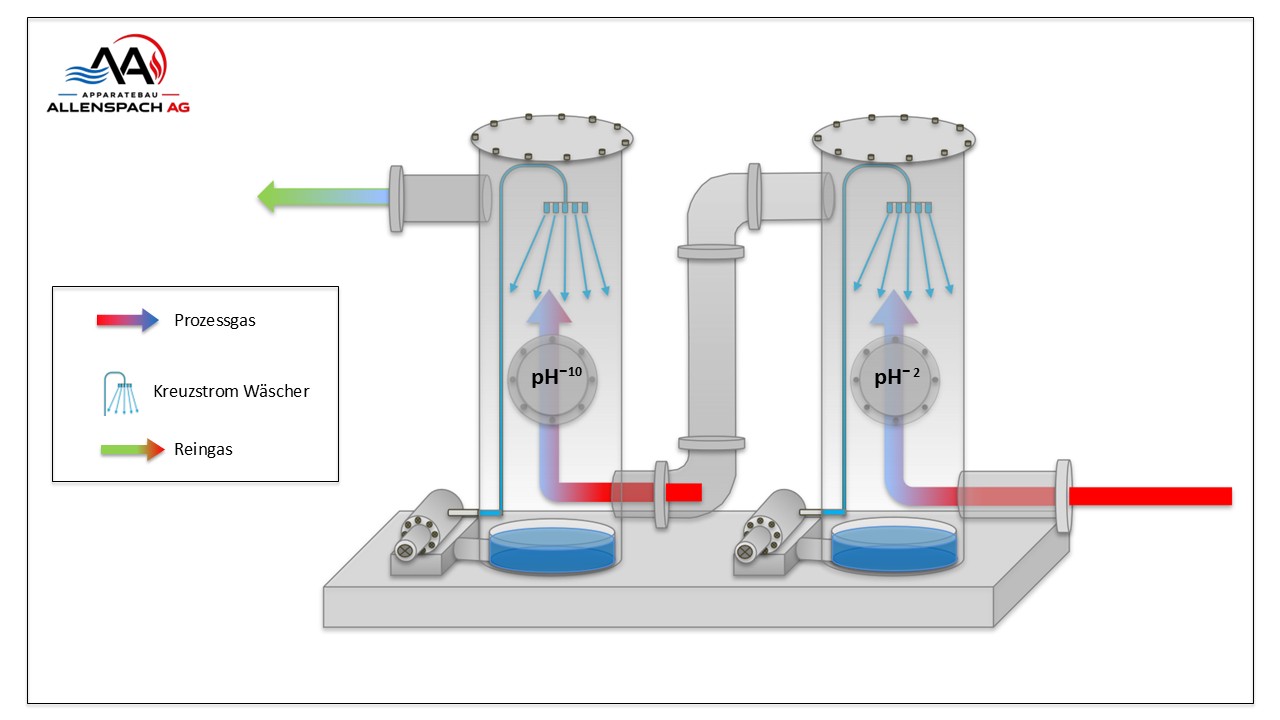
Gaseous pollutants are removed from the exhaust air stream by physical absorption or chemical reaction. A countercurrent packed-bed column is commonly used. The scrubbing liquid is sprayed into the scrubber from above via nozzles and flows over the packing into the feed tank. The exhaust air is guided countercurrent to the scrubbing liquid through the packing.
After purification, the exhaust air flows through a droplet separator that removes entrained liquid droplets. The purified exhaust air is then discharged via a stack or fed to a downstream purification stage.
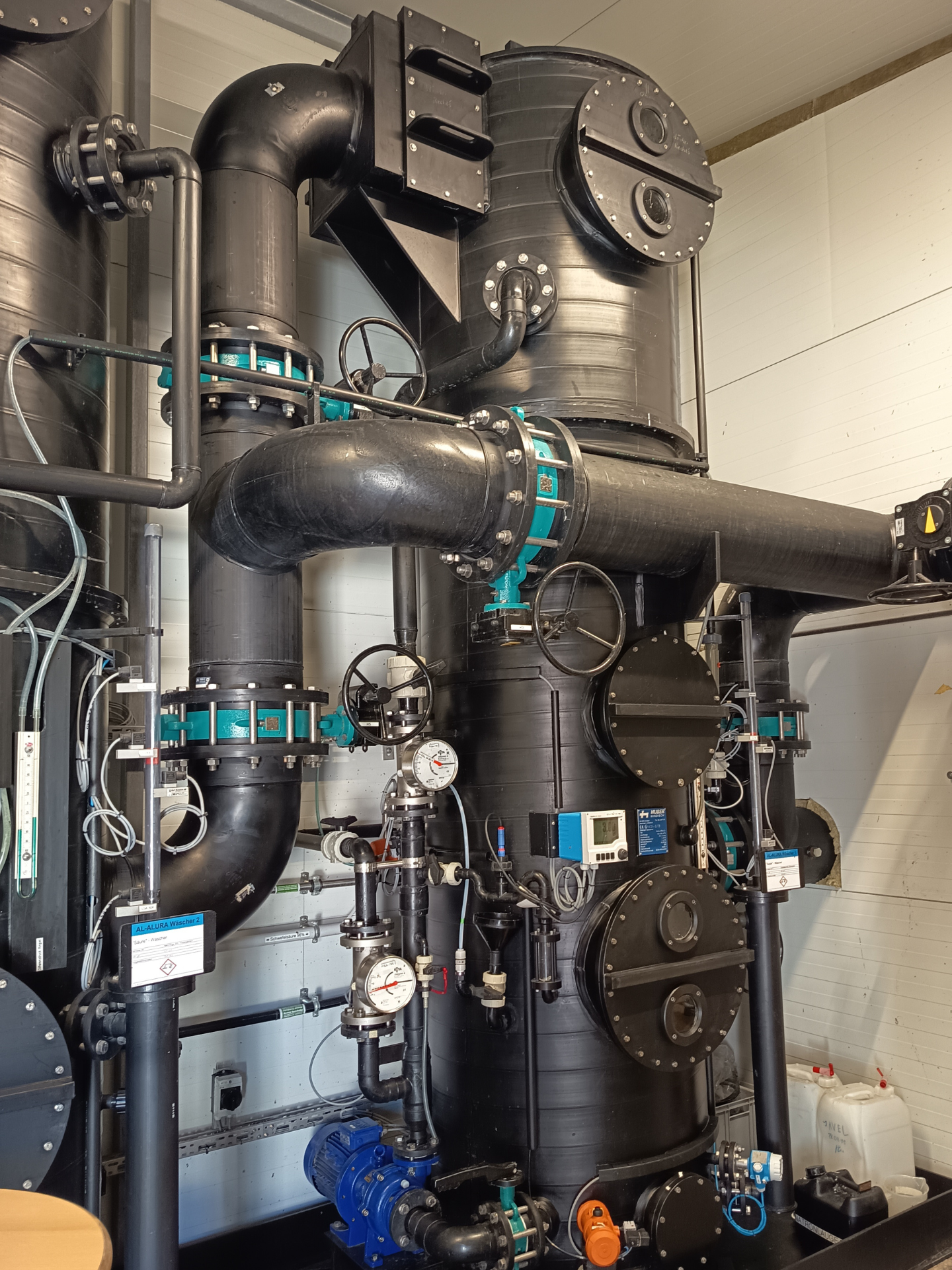
The scrubbing liquid is recirculated; make-up water, reagent dosing and blowdown are controlled as required for the application. The liquid can be continuously monitored and controlled via integrated measurement and control technology with respect to pH value, conductivity, redox potential, temperature, and level. This ensures consistently high purification performance and economical plant operation.
Exhaust air scrubbers are particularly suitable for removing water-soluble, acidic, or alkaline pollutants as well as for dust- and aerosol-laden exhaust air streams. By selecting the appropriate scrubbing medium and plant design, the process can be optimally adapted to the respective process requirements.
Features of exhaust air scrubbers
- Removal of gaseous pollutants by absorption or chemical reaction
- Dust and aerosol removal depending on the selected scrubber design; pretreatment or a dedicated particulate control stage may be required
- High removal efficiency through intensive mass transfer; values up to 99.99% apply to verified applications, depending on target pollutant, scrubbing chemistry and operating conditions
- Reliable compliance with statutory emission limits
- Use of various scrubbing media depending on pollutant type
- Integrated droplet separator to prevent entrainment
- Fully automatic operation with high plant availability
- Compact, robust, and maintenance-friendly design
- Recirculated scrubbing liquid with controlled make-up water, reagent dosing and blowdown
- Optional with pH, conductivity, redox, temperature, and level control
- Co-current designs are available where appropriate; pressure drop depends on the column design, packing and operating conditions