

Catalytic oxidation systems
Catalytic oxidation
Catalytic oxidation (CATOX) is used for the energy-efficient purification of pollutant-laden exhaust air streams containing volatile organic compounds (VOCs) and carbon monoxide (CO).
- Oxidation of volatile organic compounds (VOCs) and CO at typically approx. 250–450 °C, depending on catalyst, pollutant mixture and emissions target
- Shorter heat-up times compared to an RTO
- Lower oxidation temperatures can reduce heating demand compared with a comparable thermal oxidizer
- Reliable compliance with statutory emission limits
Technical applications of catalytic oxidation systems
- Paint and coatings industry
- Chemical industry
- Pharmaceutical industry
- Packaging industry
- Plastics industry
- Metal industry



Catalytic oxidation (CATOX)
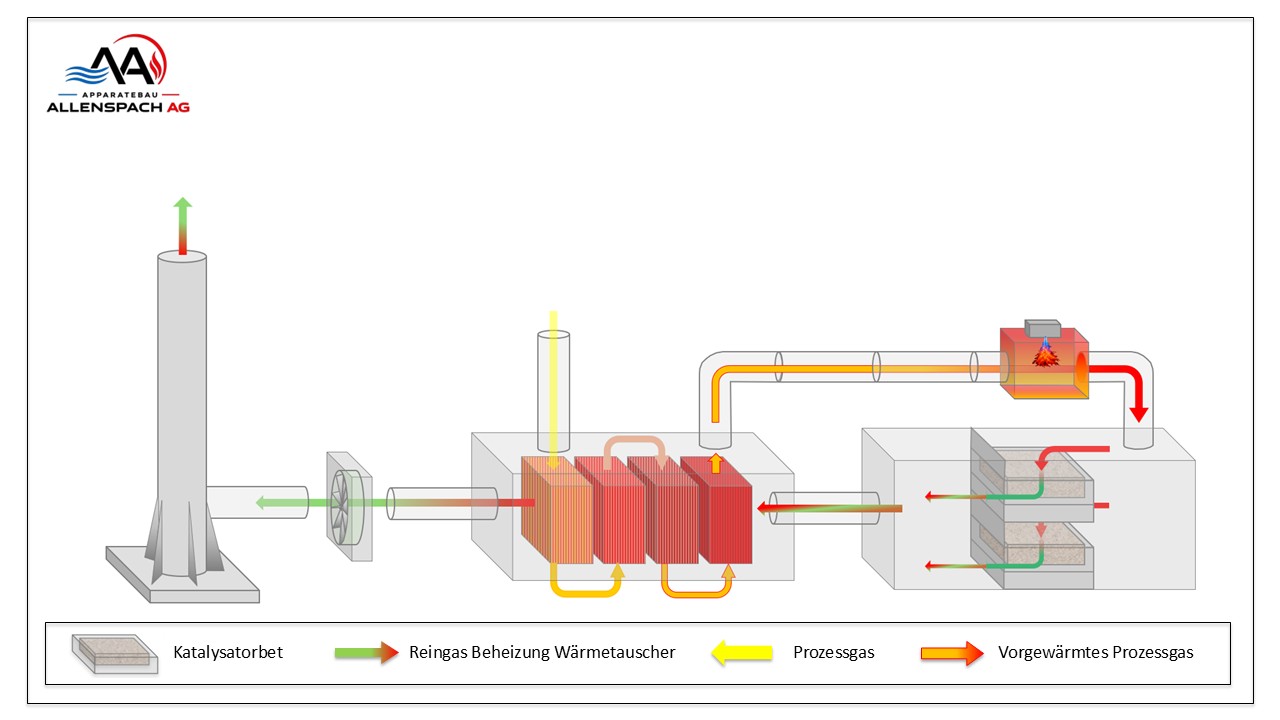
Catalytic oxidation (CATOX) uses a catalyst to treat VOC-containing exhaust air at lower temperatures than conventional thermal oxidation. It is used for the energy-efficient purification of pollutant-laden exhaust air streams containing volatile organic compounds (VOCs) and carbon monoxide (CO). The pollutant-laden exhaust air is first heated to the reaction temperature (depending on the catalyst, pollutant mixture and emissions target) and then passed through the catalyst. The catalyst promotes oxidation of carbon monoxide to CO₂ and of hydrocarbon VOCs mainly to CO₂ and water.
The energy released can be used to increase system efficiency with a recuperative heat exchanger for preheating the raw gas, thereby reducing the auxiliary energy requirement.
CATOX is particularly suitable for applications with low to medium pollutant concentrations where low energy consumption and high purification performance are prioritized. A prerequisite for long-term operation is exhaust air that is largely free of dust and catalyst poisons.
The lower oxidation temperatures compared to an RTO and the associated shorter heat-up times are particularly attractive for production facilities that do not operate daily or have interruptions.
Features of catalytic oxidation systems
- Oxidation of volatile organic compounds (VOCs) and CO at typically approx. 250–450 °C, depending on catalyst, pollutant mixture and emissions target
- Shorter heat-up times compared to an RTO
- Lower oxidation temperatures can reduce heating demand compared with a comparable thermal oxidizer
- Reliable compliance with statutory emission limits
- High purification levels at low to medium pollutant concentrations
- Optional with recuperative heat exchanger for heat recovery
- Combination with VOC concentrator possible for low-loaded exhaust air streams
- Compact design and fully automatic operation with simple handling
- Low operating costs due to reduced heating power and high energy efficiency
- Precious metal or metal oxide catalysts depending on the application